
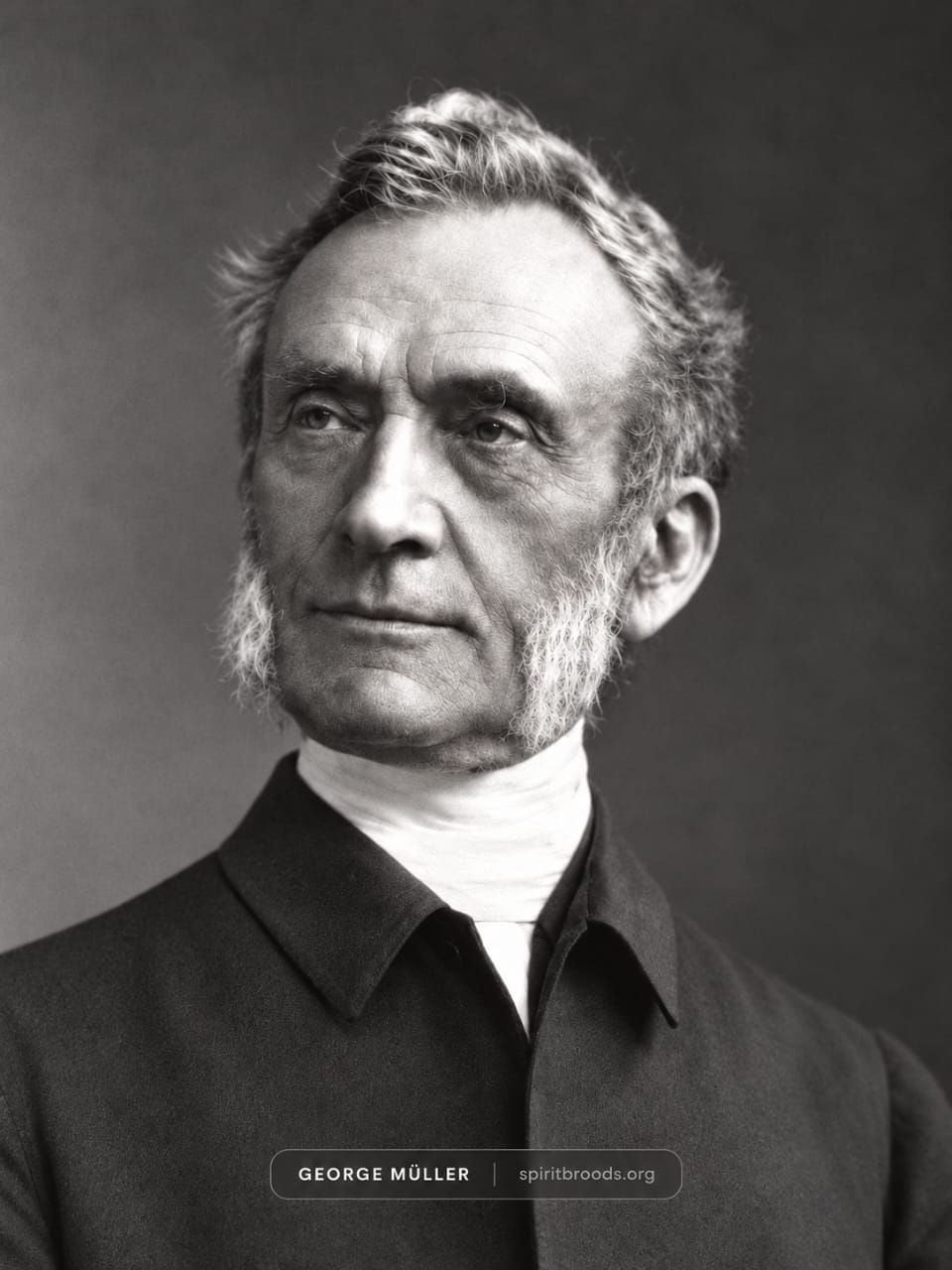
Biography
George Müller was born on September 27, 1805, in Kroppenstedt, in the kingdom of Prussia. His father was a tax collector and a man who loved money. George grew up in an unhappy home. He was a thief and a liar as a boy. At the age of ten, he stole money from his father's tax receipts. His mother died when he was fourteen, and he spent the night of her death playing cards and drinking. At sixteen, he was arrested for failing to pay a hotel bill and spent time in prison. His life was marked by gambling and dishonesty.
He studied at the University of Halle, intending to become a minister, though only for the sake of a good salary. In November 1825, a friend took him to a small prayer meeting at the home of a Christian. He was moved by what he saw. A man knelt and prayed, and he thought that he himself could never do that. That evening was the beginning of his conversion. He gave up his old life and turned to the Lord. He felt a call to missions and went to England in 1829 to study at a missionary college. He fell ill and had to leave.
He stayed in England and joined a Brethren congregation in Teignmouth. In 1830 he married Mary Groves, the sister of Anthony Norris Groves. He gave up his salary and decided to live by faith, trusting God to provide his needs. In 1832 he and Mary moved to Bristol, where he became a pastor of a congregation. In 1834 he founded the Scriptural Knowledge Institution, which established schools, distributed Bibles and supported missionaries.
He saw the plight of the orphans in Bristol, many of whom lived in the streets or in the workhouses. In 1836, he opened a home for orphan girls. It was the start of a work that grew rapidly. In 1849, he built the first of several large orphan houses on Ashley Down, on the outskirts of the city. At the height of the work, there were five large buildings housing more than two thousand children at a time. Over his lifetime, he cared for more than ten thousand orphans. He fed them, taught them to read and gave them a trade.
He never asked anyone for money. He prayed, and he recorded the answers in his journal. He did not tell people of the needs of the work, and he said that God would provide. On many occasions, the food ran out, and he prayed. A knock would come at the door with a gift. There are accounts of mornings when the tables were set with empty plates and no breakfast, and a baker arrived with bread. He kept careful accounts of every gift, and they were published in his annual reports. He received over one and a half million pounds over the course of his life, which would be hundreds of millions today.
His wife Mary died in 1870 after many years of marriage. He grieved and carried on. In 1871 he married Susannah Sangster. In 1875, at the age of seventy, he began a series of preaching tours around the world, which lasted seventeen years. He traveled to forty-two countries and preached to an estimated three million people. He crossed oceans by ship and took trains across continents. He preached in a plain and loving manner, and he stressed the importance of trust in God.
He had his struggles. He lost a daughter and a son-in-law, and he buried his second wife. He was not free from the criticism that his methods drew. Some thought that his refusal to make needs known was extreme. He did not criticize those who raised money, and he insisted that he was only following his own conviction. He also was a man of firm views and could be severe on matters of doctrine. He was an exacting teacher.
He died on March 10, 1898, at the age of ninety-two. He was found dead in his room in the morning, having prayed with his household the night before. Thousands lined the streets of Bristol for his funeral. His life shows that God can be trusted, and that a man who prays can accomplish great things for the sake of the helpless.
Sources
“We again cried to the Lord in our trouble, and the Lord heard and saved us out of all our distresses.”
Archives
He Trusted God for Everything - George Müller
Contents
A Youth Going the Wrong Way
George Müller was born on September 27, 1805, at Kroppenstedt in the Kingdom of Prussia.
His father worked as an excise collector.
The household was not organized around evangelical faith, and George later described his youth with unusual bluntness. He stole money. He lied to conceal it. He wasted money. He drank. He accumulated debts and learned how to deceive people who trusted him.
His autobiography does not present these memories as dramatic ornament. He used them to remove the idea that his later reputation for prayer came from an unusually innocent childhood.
Before the age of ten, he wrote, he had already taken government money entrusted to his father.
The pattern continued into adolescence.
At one point he was imprisoned for fraud connected with unpaid lodging. Even preparation for the ministry did not initially change him. His father wanted him educated for the clergy because it offered a respectable career and the possibility of financial security.
Müller entered the University of Halle to study theology.
He could become a minister without yet knowing the God he would later spend his life speaking about.
That contradiction broke in 1825.
Halle and the Prayer Meeting
A fellow student invited Müller to a small Christian gathering in a private home.
The meeting was unlike the formal religious environment he knew.
People prayed simply.
They read Scripture.
They spoke as though communion with God were not a professional subject but a present reality.
Müller was deeply affected.
He later regarded this period as his conversion.
The change did not make him instantly mature, but the direction of his life altered.
He began praying.
He read Scripture with a new seriousness.
He sought the company of believers.
He became interested in missionary work.
At Halle he also came under the influence of August Tholuck, the theologian associated with the evangelical renewal of German Protestantism.
Missionary ambition soon drew Müller toward England.
He initially hoped to serve among Jewish people under a missionary society.
The move would lead somewhere he did not expect.
England, Missionary Plans and a New Direction
Müller arrived in England in 1829 to prepare for work under the London Society for Promoting Christianity Amongst the Jews.
His English was limited.
His health was not strong.
The organization expected its missionaries to operate under established structures.
Müller increasingly became uncomfortable with forms of control that he believed interfered with direct dependence on God and freedom in ministry.
He withdrew.
This could look, from one angle, like instability. He had crossed countries to serve under a mission and then left it.
But a pattern was emerging.
Müller wanted Christian work to proceed without pressure, debt or manipulation.
In the south of England he became connected with Christians influenced by the growing Brethren movement.
He also met Henry Craik, a gifted preacher who became one of his closest ministry partners.
The two eventually served together in Bristol.
Before that, Müller made another decision that shaped the rest of his life.
Mary Groves and the Decision to Live by Faith
In 1830 Müller married Mary Groves.
Mary came from a family already associated with radical evangelical commitment and missionary concern.
Their marriage became a working partnership.
Soon after marrying, Müller gave up the fixed salary connected with his pastoral position.
He believed ministers should not depend on compulsory pew rents or systems that could make poor people feel excluded from church life. He preferred to receive voluntary gifts without directly asking individuals for his personal support.
The decision became the foundation of his later reputation.
It is important to define it carefully.
Müller did not believe Christians must never tell anyone about a ministry.
He published extensive reports.
He described work already being done and recorded income and expenditure.
People therefore knew about the needs in a general sense.
What he refused to do was make direct appeals for money when a specific need arose.
He would pray instead.
He also refused to go into debt.
That discipline was practical as well as theological.
If money was not present, he waited.
Bristol and Bethesda Chapel
In 1832 Müller and Henry Craik moved to Bristol.
They became associated with Bethesda Chapel.
Bristol was a major port city marked by wealth and poverty side by side.
Müller’s pastoral work brought him into close contact with families for whom sickness or death could mean immediate economic disaster.
He preached.
He taught Scripture.
He visited.
He also became increasingly concerned with the lack of Christian education and the instability faced by poor children.
The church setting mattered because the orphan houses did not arise from a philanthropist working separately from pastoral ministry.
They came out of the same conviction that Christian faith should be visible in ordinary life.
Müller also wanted believers to trust Scripture directly.
He resisted dependence upon ecclesiastical rank and formal denominational control.
This placed him broadly within the early Open Brethren world, though his public identity became larger than that movement.
The Scriptural Knowledge Institution
In 1834 Müller and Craik established the Scriptural Knowledge Institution for Home and Abroad.
Its objects included supporting schools, circulating the Bible and Christian literature, and assisting missionaries.
The institution was built around several principles.
It would not incur debt.
It would not seek money through ordinary fundraising appeals.
It would depend upon voluntary gifts.
It would try to operate without denominational restriction where shared evangelical convictions allowed cooperation.
The institution became the administrative structure through which much of Müller’s later work was conducted.
This detail is important because popular retellings can make his life sound almost administratively effortless.
It was not.
Prayer did not remove bookkeeping.
Someone had to hire staff.
Someone had to buy food.
Someone had to maintain buildings, educate children, answer letters and keep accounts.
Müller’s distinctive conviction was not that organization was unspiritual.
It was that organization should not replace dependence upon God.
Why the Orphan Work Began
By the mid-1830s Müller had become convinced that an orphan house should be established in Bristol.
Compassion was part of the reason.
Children who had lost both parents could face poverty, exploitation and institutional conditions that varied widely in quality.
But Müller stated another reason very plainly.
He wanted the work to become visible evidence to Christians that God hears prayer.
He believed many believers trusted God in doctrine while living anxiously in practice.
If an institution caring for children could operate without direct financial appeals and without debt, he believed it could demonstrate that God was not merely an idea from Scripture.
This motive can sound uncomfortable to modern ears.
Were orphans being used as an experiment in faith?
Müller himself rejected that implication.
The children were to be housed, fed, educated and prepared for adult life with care.
But he never hid the apologetic purpose.
The institution existed both to care for children and to strengthen faith in the church.
Wilson Street
The first orphan house opened in rented premises on Wilson Street in Bristol in 1836.
Girls were admitted first.
Additional houses followed as applications increased.
Soon infants and boys were also being received.
The work grew quickly.
With growth came pressure.
There were days when money was low.
There were occasions when food supplies were close to exhaustion.
Müller’s journals recorded these periods in detail because they were central to the testimony he wanted the work to bear.
He prayed with coworkers.
Gifts arrived.
Sometimes the timing was striking.
These records later generated many popular stories.
Some can be traced closely to Müller’s own narratives.
Others were retold over generations and became more polished than the source record.
The strongest historical case for Müller’s practice does not depend on any one dramatic breakfast story.
It rests on decades of accounts, gifts, expenditures and correspondence showing that the work actually operated according to the unusual financial rule he had adopted.
Prayer, Provision and the Discipline of Not Asking
Müller’s method has sometimes been summarized as though he simply waited for miracles.
That misses the discipline involved.
He kept careful financial records.
He distinguished funds given for different purposes.
He refused to redirect restricted gifts merely because another account was short.
He paid bills rather than building debt.
He investigated needs.
He made decisions about admissions, staff and buildings.
He prayed repeatedly over specific shortages.
He also published reports after the fact.
The reports informed supporters and inevitably encouraged future giving even though they did not function as emergency appeals.
This is one place where his example must be understood rather than mechanically copied.
Müller believed God had given him a particular way of working.
He did not teach that every Christian institution must avoid all direct fundraising in exactly the same manner.
His purpose was testimony.
He wanted the absence of direct appeals to make provision visible as an answer to prayer.
The principle was not financial passivity.
It was refusal to manipulate.
Ashley Down
The Wilson Street houses eventually created problems for the surrounding neighbourhood.
There were many children in a residential street.
Noise increased.
Space was inadequate.
Sanitation and outdoor recreation became difficult.
Müller began praying about building a larger purpose-designed home.
The financial scale was far beyond anything the work had previously attempted.
He refused debt.
Land was eventually acquired at Ashley Down outside central Bristol.
The first new orphan house opened in 1849.
Expansion continued over decades.
Eventually five large houses stood there with capacity for more than two thousand children and the staff required to care for them.
The buildings themselves became part of the witness Müller intended.
Visitors could see stone, rooms, classrooms, kitchens, beds and children.
Faith had not produced an invisible result.
It had produced an institution that required thousands of meals and years of maintenance.
The scale also brought new questions.
An operation this large depended not only on the faith of one man but on the labour of many people whose names are far less remembered.
Teachers, matrons, administrators, cooks, workers and supporters all carried the burden.
A mature history must remember them.
Administration Behind the Stories
Müller possessed an unusually strong administrative mind.
He could organize large amounts of information and maintain routines over decades.
His record keeping became one reason the orphan work could be trusted by donors.
Income and expenses were reported.
Numbers of children were tracked.
Schools and literature distribution were documented.
This does not mean every figure repeated in later biographies should be accepted without checking dates and definitions.
Totals vary depending on whether writers refer to the number housed at one time, the total admitted during Müller’s lifetime, the later life of the institution or the wider work of the Scriptural Knowledge Institution.
But the broad scale is beyond dispute.
Thousands of children passed through the homes.
Schools supported through the institution educated many more.
Bibles and Christian literature were distributed widely.
Missionaries received assistance.
Prayer may be the most famous feature of the story.
Administration is one of the reasons the story lasted.
Children, Education and the Limits of Victorian Care
The orphan houses should also be judged within their nineteenth-century setting without assuming that good intentions made every practice ideal.
The children lived under institutional discipline.
Daily schedules were ordered.
Biblical instruction was central.
Girls were commonly trained for domestic service.
Boys were apprenticed into trades or other employment.
Some children who showed aptitude were trained as teachers.
By Victorian standards, the homes were often regarded as unusually well run.
Children received food, clothing, education and vocational preparation.
Müller wanted them to leave capable of supporting themselves.
Yet institutional care is never the same as family life.
Modern readers should not romanticize the orphanage simply because the founder was devout.
Large institutions can protect children from one set of dangers while creating other forms of emotional limitation.
The surviving record contains gratitude from many former residents, but no institution serving thousands of children should be treated as though every experience was identical.
Müller’s strongest claim was more modest.
The children would be cared for without the work using financial pressure to sustain itself.
Loss, Mary’s Death and a Second Marriage
Mary Müller worked beside George through the long expansion of the ministry.
They had children of their own, though their son Elijah died in infancy. Their daughter Lydia survived into adulthood and became closely involved with the work.
In February 1870 Mary died.
George had preached and written about trusting God through difficulty for decades.
Her death tested those convictions personally.
He did not hide grief.
He preached at her funeral and spoke of God’s goodness without pretending bereavement did not hurt.
In 1871 he married Susannah Grace Sanger.
The second marriage began another stage of life.
Müller was already in his sixties.
Many people would have regarded his major work as complete.
Instead, a period of extensive travel began.
Seventeen Years of Missionary Travel
From the mid-1870s into old age, Müller travelled internationally with Susannah.
The journeys took him through Europe, North America, Asia, Australia and other regions.
He preached to Christians about Scripture, prayer, dependence on God and missionary responsibility.
He also preached evangelistically.
The tours extended his influence far beyond Bristol.
People who knew the orphan work as a story now heard the man whose journals had shaped it.
The travel was physically demanding.
Müller was no longer young.
But he believed the years after active day-to-day oversight of the orphan houses could be used to strengthen churches.
Leadership of the Bristol institutions increasingly rested with others, especially James Wright, who was also Müller’s son-in-law.
This transition matters.
The work survived because authority could move beyond its founder.
Old Age and Death in Bristol
Susannah died in 1894.
Müller continued living in Bristol.
He remained active in preaching and prayer into his nineties.
On March 10, 1898, he was found dead in his room.
He was ninety-two.
His funeral drew large numbers of people.
By then the orphan houses were a visible Bristol institution and his name was known internationally.
He had spent more than sixty years in work connected with the city.
The physical buildings outlived him.
The organizations changed over time.
Residential models of orphan care eventually changed too.
But his published narrative continued travelling into Christian homes far beyond Britain.
What Müller's Life Does and Does Not Prove
George Müller’s life has often been used as a collection of spectacular answers to prayer.
That can actually make the story smaller.
The strongest evidence is not one moment when food appeared before breakfast.
It is the length of the experiment.
Year after year an institution had to function.
Children had to eat tomorrow after they had eaten today.
Buildings had to be repaired after they were built.
Workers had to remain supported after the excitement of a new project passed.
Müller’s life was therefore less about repeated emergencies than about sustained dependence joined to sustained administration.
His example also requires boundaries.
It does not prove that every faithful Christian will receive every material request.
It does not mean organizations that make honest financial appeals lack faith.
It does not mean planning is opposed to prayer.
Müller planned extensively.
What distinguished him was the rule he believed God had given his own work: no direct personal solicitation for specific needs and no debt.
He kept that rule for decades.
The young man who once stole money from his father became a steward trusted with enormous sums.
The theology student who entered university with little spiritual reality became a pastor remembered for prayer.
The former prisoner for fraud became responsible for institutions caring for vulnerable children.
That transformation is at least as important as the money that arrived.
George Müller wanted the church to believe that God was living and attentive.
His method was to make his whole work depend visibly upon that conviction.
Sources and references
- • George Müller, A Narrative of Some of the Lord’s Dealings with George Müller / autobiographical journals. • Scriptural Knowledge Institution reports and financial records. • George Müller of Bristol and related early biographical material by Arthur T. Pierson. • Contemporary accounts from Mary Müller, coworkers and former residents of the orphan houses. • George Müller Trust historical resources on Wilson Street, Ashley Down and the later development of the work.