
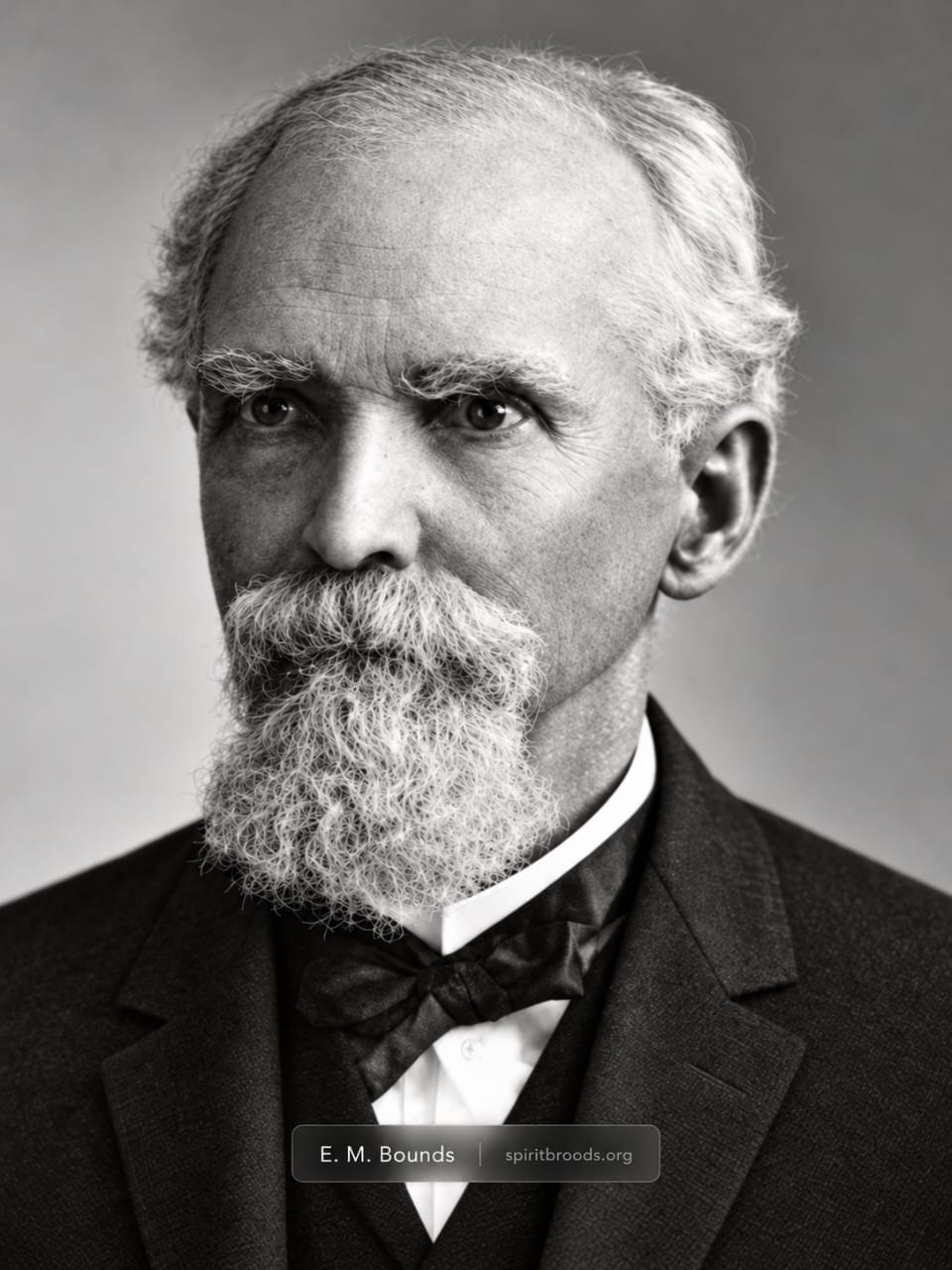
Biography
Edward McKendree Bounds was born on August 15, 1835, in Shelby County, Missouri. He came of age in a country whose expansion and disputes about slavery were moving toward the crisis of civil war. He received his early education in Shelbyville and prepared for a legal career, being admitted to the bar while still a young man. He practised law for a time. The orderly reasoning expected of an attorney suited his mind, but his life took another direction when he became convinced that he should preach. At about twenty-four he entered the Methodist ministry, serving congregations in Missouri that had their own social divisions and daily difficulties.
His first appointment was in the Monticello circuit of the Methodist Episcopal Church, South. A circuit preacher had to serve more than one congregation and move among people whose resources could be limited. Bounds learned the work of teaching, visiting and preparing sermons before his name became associated with printed books. His commitments belonged to a Southern Methodist denomination whose history included divisions over slavery. An honest biography cannot remove that context. Religious conviction did not place him outside the political and moral conflicts of his time.
When the Civil War began in 1861, Bounds was serving a church at Brunswick, Missouri. He refused to take an oath of allegiance to the federal government, was arrested and held as a prisoner. Later accounts say he was moved from St. Louis to Memphis before obtaining his release. He then travelled south and became a chaplain with a Missouri Confederate regiment. His service placed him among soldiers who experienced exhaustion, death, injury and the uncertainties of military life. He was arrested again late in the war and held at Nashville. These years have sometimes been reduced to a story of courage under persecution, but they also involved his choice to serve the Confederacy, a cause inseparable from the preservation of slavery.
The end of the war left communities in the South struggling with bereavement and economic ruin. Bounds returned to pastoral work, serving churches in Tennessee and Alabama. In Franklin, Tennessee, accounts describe his efforts to encourage people through meetings for prayer. The town carried memories of a devastating battle fought in November 1864. Any ministry there took place among people living with the damage of conflict, although surviving biographical sketches tell more about Bounds's own work than about the experiences of Black residents or formerly enslaved people. His ministry should therefore be placed within the real history of Reconstruction rather than treated only as a private spiritual exercise.
In the 1870s Bounds served in St. Louis, including at St. Paul Methodist Church. His preaching gained attention beyond individual congregations. He became known for energy in the pulpit and for the seriousness with which he approached Scripture. In 1876 he married Emmie Barnett, a woman from Georgia. They began a family while his work required travel and new appointments. Children were born, and the household experienced both joy and bereavement. His first wife died in 1886. Bounds later married her relative Hattie Barnett in 1887, beginning a second marriage that continued until his death. The exact number of children and their individual dates should be checked against family registers, since brief historical summaries do not always count them in the same way.
Bounds also worked with the Christian Advocate, a Methodist newspaper in St. Louis. He eventually became associated with the Southern Christian Advocate, then published in Georgia. Editing asked something different of him from preaching to the people assembled on Sunday. He had to judge articles, prepare his own writing and respond to public questions affecting the Methodist churches. Newspaper work could carry an argument beyond the churches he served in person. It also demanded discipline and consistency. His later reputation as a writer of books on prayer developed from years when writing was one of the regular tasks of his ministry.
In the 1890s he returned to Washington, Georgia, where he spent much of his remaining life. As he withdrew from the demands of regular pastoral appointments, he gave more time to prayer, reading and writing. His friend Homer W. Hodge later wrote that Bounds rose at four in the morning for many years and spent substantial time in private prayer. That account is a contemporary associate's reminiscence rather than a diary recording every day of his life, but it shows the impression he left upon those who knew him. He was not merely explaining prayer in public. He was trying to make it the governing practice of his own days.
His writing approached prayer as something closely connected with character and ministry. He believed that a sermon could be carefully prepared and yet lack the spiritual life needed to serve its hearers. In his books, the preacher's secret life mattered as much as skill in public speaking. Prayer, he argued, was not an ornament added to religious work after everything else had been arranged. It belonged to the very labour of preaching, leadership and service. His writing returned repeatedly to a concern that Christians could become occupied with religious activity while neglecting the habits by which their faith was sustained.
The books did not appear in the form now familiar to many readers during his lifetime. Two volumes associated with his teaching on prayer were published while he was alive, including Preacher and Prayer, which later circulated under other titles. Many other collections came later. His friend Claude Lysias Chilton worked with surviving manuscripts and helped arrange their publication. This distinction matters because a modern shelf of books bearing Bounds's name can create the impression that he released a long series of finished volumes one after another. In reality, editors and publishers gave much of the material its final printed form after his death.
There is an important difference between reading his books as devotional counsel and treating every sentence in them as the complete history of his life. His repeated emphasis on prayer could make him appear almost detached from ordinary responsibilities. Yet he had been a lawyer, a Confederate chaplain, a pastor, an editor, a husband and a father. He had made decisions in a divided nation and lived through family grief. His writings do not answer every question that those choices raise, and they do not excuse his position in the Civil War. They show how, in later life, he understood the need for dependence upon God and the dangers he saw in ministry driven by activity alone.
Bounds died in Washington, Georgia, on August 24, 1913, nine days after his seventy-eighth birthday. Hattie survived him, together with members of the family. His manuscripts continued to be edited and read, and the later publishing history carried his name far beyond the congregations where he had preached. Readers encountering him through a single quotation about prayer may know little of the Missouri lawyer, the contested loyalties of the Civil War or the family and newspaper work that occupied his life. Those parts belong in the record. The enduring burden of his writing was that prayer should be a real practice sustaining the life of the believer, rather than a phrase used to praise devotion while the hours and habits of prayer are neglected.
Sources and references
- Homer W. Hodge, personal biography (1920 introduction) transcribed by E. M. Bounds archive
- Christian Classics Ethereal Library, scholarly bibliographic biography and texts
- Christian Classics Ethereal Library, Edward McKendree Bounds author works
- E. M. Bounds archived writing and individual publication metadata
- Public historical timeline and bibliography; cross-check dates against original registers
Sources
“Prayer makes the man; prayer makes the preacher; prayer makes the pastor.”
“Men are God’s method. The Church is looking for better methods; God is looking for better men.”
“The sermon cannot rise in its life-giving forces above the man.”
“Dead men give out dead sermons, and dead sermons kill.”
“Preaching is not the performance of an hour. It is the outflow of a life.”
“It takes twenty years to make a sermon, because it takes twenty years to make the man.”
“The preacher’s sharpest and strongest preaching should be to himself.”
“The preaching man is to be the praying man. Prayer is the preacher’s mightiest weapon.”
“The little estimate we put on prayer is evident from the little time we give to it.”
“Perhaps little praying is worse than no praying.”
“Little praying is a kind of make-believe, a salve for the conscience, a farce and a delusion.”
“Much time spent with God is the secret of all successful praying.”
“God’s acquaintance is not made by pop calls.”
“Much with God alone is the secret of knowing Him and of influence with Him.”
“The character of our praying will determine the character of our preaching.”
“Light praying will make light preaching.”
“No learning can make up for the failure to pray. No earnestness, no diligence, no study, no gifts will supply its lack.”
“Talking to men for God is a great thing, but talking to God for men is greater still.”
“Prayerless words in the pulpit and out of it are deadening words.”
“Prayer, much prayer, is the price of preaching unction; prayer, much prayer, is the one, sole condition of keeping this unction.”
“Without unceasing prayer the unction never comes to the preacher.”
Archives
Power Through Prayer - E. M. Bounds
Contents
Missouri and the Law
Edward McKendree Bounds was born on 15 August 1835 in Shelby County, Missouri. He belonged to the generation whose adult life would be divided by the American Civil War. The state in which he grew up stood at the meeting point of competing regional loyalties: Missouri entered the Union as a slave state, and its communities were tied to the political and economic conflicts that eventually brought war. Bounds would become a minister on the Confederate side. That later fact should not be hidden behind the prayer books for which he is now remembered.
His schooling in Shelbyville prepared him for professional rather than clerical life. As a young man he entered legal practice and was admitted to the bar. He was still in his twenties when he began to move from the courtroom to the pulpit. The transition has sometimes been told as though his legal training was useless once preaching began. In fact, his later writing retained something of an advocate’s insistence: arguments were developed, repeated, pressed and brought back to the same practical question.
It would also be misleading to describe his early years as a long period of literary preparation. He was not yet the writer of familiar volumes about prayer. He was a Missouri lawyer whose life became bound up with Methodism and with a nation approaching catastrophe. Bounds’s passage from law to ministry was made amid the religious awakenings of the 1850s. Accounts of his early years associate the decision with revival meetings and with further preparation for Methodist service. He entered the Centenary Seminary circle at Palmyra, Missouri, and received an appointment to the Monticello circuit in 1859. His first parishes were far removed from the later image of an author whose prayer books circulated around the world.
Methodist ministry in rural Missouri was both religious and social work. A preacher was expected to visit dispersed families, attend quarterly meetings and respond to needs that could not be resolved by a sermon. In a border state with divided allegiances and enslaved people held under law, the preacher’s calling was also inseparable from the public order around him. The Methodist split of 1844 had made the question of slavery part of the denominational landscape before Bounds was old enough to hold office.
The surviving sources tell us less about how he personally explained every social issue than about the institutions he served. That difference is important. It allows the record to state what is known without rewriting his beliefs to fit either a celebratory or a condemnatory narrative. He was formed as a minister in a church which had made its accommodation with southern slavery, and the coming war would expose the consequences of that history.
The Call to Methodist Ministry
Bounds entered the ministry of the Methodist Episcopal Church, South, and around 1859 began serving the Monticello circuit. He was approximately twenty-four. The Methodist circuit system placed preachers in communities and neighbouring appointments where duties included preaching, visiting families, travelling between congregations, attending to church discipline and holding services in buildings far removed from the major pulpits of American religion.
The denomination itself had already been marked by sectional division. The Methodist Episcopal Church divided in 1844 over slavery and related questions of church authority, and the southern church developed within the social order of the slaveholding states. Bounds did not stand outside that history. It shaped the institutions in which he became a minister, the people among whom he worked and the decisions he would make during the war.
Later devotional accounts often introduce Bounds with the statement that he gave up a promising legal career because God called him to preach. That is faithful to the broad outline of the transition, but it is not a substitute for the less glamorous facts of the work that followed. He received ordinary pastoral appointments, faced church responsibilities and served within a denomination with theological commitments and political entanglements. His later writing about the minister’s prayer life grew out of years spent inside the structures of ministry, not out of withdrawal from them at the beginning.
A Minister on the Confederate Side
The Civil War came while Bounds was serving in Missouri. In his later biographical introduction, Homer W. Hodge reported that Bounds was imprisoned by federal authorities after refusing to take an oath of allegiance to the United States government. He was held in St. Louis and later sent to Memphis before obtaining his release. The precise length and circumstances of his confinement differ among later retellings, but the basic sequence is present in early biographical testimony.
Bounds subsequently joined a Confederate command and served as a military chaplain, traditionally identified in early accounts with a Missouri regiment. His work brought Christian ministry into direct contact with the life of an army at war. Chaplains preached, prayed, visited the sick and injured, assisted dying men and conducted funerals. These were acts of ministry performed inside a military structure fighting for a political cause.
No account should turn the chaplain’s service into proof that the Confederate cause was righteous. Secession and slavery are inseparable from the historical setting of that war. The evidence for Bounds’s personal views on every political issue is not equally clear, and it would be improper to invent private motives or absolve him of the implications of his public allegiance. What can be established is that he ministered among Confederate forces and experienced imprisonment and the violence of wartime life.
This is an uncomfortable fact for readers who know him only through paragraphs about prayer. It belongs in the record because a faithful biography does not ask that admiration erase context. A person may write enduringly useful Christian counsel and still stand inside a movement whose cause requires moral examination. An early account by Homer W. Hodge places Bounds’s imprisonment after his refusal to take a federal loyalty oath while serving in Missouri. He was transferred from St. Louis to Memphis and later joined a Confederate command. These are not decorative incidents in an otherwise devotional life. They meant the loss of ordinary pastoral security and commitment to a military organisation fighting the Union. The Fifth Missouri Regiment appears in the early biographical description of his chaplaincy.
A military chaplain’s duties could be relentless even when a surviving biography provides few details of a particular day. Camps needed religious services, hospital tents received men with serious wounds, burial parties worked after combat and commanders had to reckon with discipline and fear. The historical record gives Bounds’s office and some movements; it does not license imaginary speeches over the wounded or invented accounts of secret heroism. The experiences are significant without those embellishments.
The Battle of Franklin in late 1864 produced extraordinary casualties in a comparatively small area. Bounds’s later pastoral connection with the town occurred in the aftermath of that destruction. Families were living amid graves and damaged property, and veterans carried the physical and mental consequences of war. The religious work of a Confederate chaplain returning to such a community was bound up with both consolation and the memories of a defeated rebellion.
It is necessary to say plainly that the Confederacy’s political project rested upon the preservation of slavery, even where an individual chaplain’s personal views are imperfectly documented. Ministry among soldiers cannot be described apart from the cause for which they fought. Bounds’s later Christian counsel may be studied for its own merit, but historical understanding requires that moral setting to remain visible.
Imprisonment, War and Franklin
By the closing stages of the war Bounds had experienced the insecurity of movement across battle lines. Some later accounts place a further capture after fighting near Franklin, Tennessee, and report another period of imprisonment. Hodge’s early sketch confirms a second capture toward the war’s end and imprisonment in Nashville. Particular battlefield injuries described in modern summaries should not be repeated as certain without documentary corroboration.
Franklin occupies a special place in the story because Bounds later ministered among people who had suffered through its fighting. The town had witnessed major military operations and terrible losses. In that setting, pastoral work could not be separated from bereavement, economic disruption and the bitterness of defeat. His return was not the beginning of an untroubled private devotional life.
The war remains a boundary in his life. Before it, Bounds had been a young minister building a vocation. After it, he worked in communities struggling to rebuild. The books later written about prayer were shaped by decades on the far side of that national disaster. But historians should resist claiming that any one battlefield experience produced a specific later doctrine unless the documentary connection can actually be shown. In Franklin Bounds became associated with a small prayer gathering that later biographical accounts remembered as having a significant effect upon the congregation. Some recollections describe half a dozen men meeting regularly and reports of renewed church life. Such testimony is valuable for understanding his pastoral priorities, though claims about particular numbers of conversions need the same documentary caution applied to revival reports elsewhere.
The town was one of many southern communities trying to recover after the surrender of Confederate armies. The legal ending of slavery did not produce an immediate settlement of social or economic life. The war had broken institutions, taken lives and sharpened racial and political conflicts. Methodists in the South were also addressing the future of a church whose denominational history had been tied to the slaveholding states.
Bounds’s work was carried out inside that reconstruction, not on a separate devotional plane. The preacher who visited homes, conducted prayer meetings and addressed congregations had to live among people whose fortunes had changed and whose views of the war were not necessarily the same. His published books rarely offer a sustained political analysis of these years, and one must not invent such an analysis on his behalf.
His later insistence that prayer should shape the minister’s life appears in many accounts of the Franklin pastorate. That connection is plausible given his teaching, but the details should remain grounded in the actual memories that survive. The significance of the period is that it joined prayer with ordinary pastoral labour amid a society undergoing painful change.
Rebuilding Pastoral Life after the War
After the Confederacy’s defeat Bounds returned to church ministry, serving in Tennessee and Alabama as well as Missouri. The post-war southern Methodist world was under pressure. Congregations were rebuilding property and membership, trying to maintain pastoral support and debating their public role in a society transformed by emancipation and Reconstruction.
Hodge’s account places Bounds among those ministering after the war and records later work in several important urban pulpits. Other biographies tell of his interest in prayer meetings in Franklin and of renewed church life there. Where such reports are preserved mainly through devotional recollection, they are best presented as testimony about the period rather than used to calculate confidently the scale of a revival.
Bounds’s pastoral work involved the ordinary labour of Christian ministry: regular sermons, administration, pastoral visits and church relationships. He knew the recurring demands that can push prayer aside even in a minister’s schedule. When he later wrote against reliance on preaching methods, he was speaking as someone who understood both the necessity and the temptation of the preacher’s craft. Family records make the household easier to see. Edward and Emmie’s children were Celeste, Corneille and a son, Edward. When Emmie died in 1886, the children were still young. The loss placed Bounds in the position of a minister and working father who had to care for a grieving family while continuing his public responsibilities. The general statement that he suffered bereavement is true but does not convey the practical burden.
He married Hattie in 1887. Their children included Samuel, Charles, Osborne, Elizabeth, Mary and a daughter also named Emmie. Two sons in the wider family died young: Edward, from the first marriage, and Charles, from the second. Not every family source supplies the same detail, but the broad outline is clear. The household was substantial, and more than one bereavement left its mark.
This matters for interpreting the discipline of prayer which friends described in his later years. The hours spent reading and praying belonged to the life of a husband and father, not a man without domestic claims. His surviving published work gives comparatively little space to the individual biographies of his children, so a later writer should resist inventing their conversations or explaining their feelings.
The fuller family history also changes the impression created by his austere reputation. Even those who admired his prayer life remembered a person embedded in relationships, household decisions and losses. Those realities help readers understand the setting in which the books were written without turning suffering into a sentimental device.
Marriage, Children and Bereavement
In 1876 Bounds married Emma Elizabeth Barnett, often called Emmie, of Eufaula, Alabama. Their household included children, and family life was accompanied by grief. Emmie died in 1886. The following year Bounds married Harriet Elizabeth Barnett, known as Hattie, who was related to his first wife. Additional children were born into the second marriage. Several children in the extended household died young.
The names and order of the children are recorded in later family-based biographies, but a short witness record need not compress that family into statistics. The essential point is that Bounds’s later practice of prayer developed within the realities of marriage, parenthood, bereavement and the upkeep of a household. It was not the routine of a man without dependants or domestic pressures.
His writings do not always pause to describe the experiences behind a particular paragraph. That leaves limits on what can responsibly be inferred from his grief. There is no need to turn the loss of a wife or child into a conveniently explained source of every subsequent statement about dependence on God. It is enough to recognise that his teaching took shape while he bore responsibilities and sorrow that a biographical profile can otherwise leave invisible. Bounds’s appointments in St. Louis show the variety of responsibilities he carried. He served St. Paul Methodist Church, was assigned for a period to First Methodist and returned to St. Paul before moving more fully into denominational journalism. Such movements reflected the Methodist system of appointments, in which the church conference rather than the minister alone determined the place of service.
Later biographical research describes him as a pastor who expected personal religion to be visible in congregational practice. This could make him difficult for parishioners who were satisfied with respectable church attendance but disliked searching preaching. His work in a prosperous urban congregation therefore differed from ministry in a small, war-damaged town. It required attention to social expectations, church governance and the pressures of an established city ministry.
In 1883 he moved into editorial work with the St. Louis Advocate. The denominational paper placed him within a world of arguments about church discipline, education, public policy and the duties of Methodist ministers. He later served the Nashville Christian Advocate. Newspaper work demanded deadlines, decisions about what deserved publication, and the care required to make complicated disputes intelligible to ordinary readers.
The editorial career complicates the way later quotations are sometimes used. Bounds knew the value of printed communication and the practical machinery required to sustain it. His later rebuke of religion reduced to methods was not a declaration that organisations and newspapers should disappear. He was questioning whether those means could compensate for the character and inward life of the people who directed them.
His disagreements with denominational authorities should not be made into a dramatic rebellion without stronger documentation. The published accounts suggest friction over evangelistic concerns and church practice. They are sufficient to show an uneasy relationship, but not to supply imaginary private discussions or to settle every party’s motives.
Pastorates and the Christian Advocate
The years in Missouri included service at St. Paul Methodist Church in St. Louis beginning in the middle of the 1870s, with later appointments in the city. Bounds also moved into denominational religious journalism. He worked with the St. Louis Christian Advocate and later with the Nashville Christian Advocate, part of the Methodist press through which ministers and members discussed doctrine, education, church policy and public questions.
This editorial service is important to the history of the books. Bounds knew print culture well before his manuscripts on prayer were gathered for a wider audience. He edited copy, wrote for Christian readers and moved in institutions that depended upon the regular production of material. The modern image of a solitary man writing only after hours of secret prayer therefore captures a genuine late-life discipline but misses his earlier experience as a working professional editor.
His period in the denominational press eventually ended amid tensions concerning church practice and the place of evangelistic work. Later accounts connect his departure to disagreements with Methodist leadership. The contours of those disagreements warrant care: it would be unsound to dramatise a single meeting or supply words exchanged behind closed doors unless a reliable contemporary record supports the scene.
His years of writing also formed an individual style. Bounds could be forceful and repetitive, insistent on spiritual realities in a period of growing institutional confidence. His concern did not amount to a rejection of every organisational instrument—he had served churches and edited their papers. It was a warning that a good institutional mechanism could not create inward life by itself.
Washington, Georgia
In the 1890s Bounds settled with his family in Washington, Georgia. Most of his remaining years were spent there, with occasional preaching engagements but without the same public denominational office. This change in circumstances is sometimes called retirement. It was not retirement in the modern sense of complete withdrawal from work. He read, prayed, wrote, corresponded and attempted to strengthen the church through the materials he was preparing.
Friends described an established habit of rising very early, often around four in the morning, and setting aside substantial hours for prayer. The detail has become famous and can easily be mishandled. Nothing in the historical record warrants telling every reader that the same hour or duration is spiritually necessary. Bounds’s practice showed the priority he gave to prayer within his own life; the significance lies in the years of discipline rather than the particular clock time.
He continued reading Scripture and reflecting on the ministry of preachers. A man who had administered congregations and worked in the press was now devoting much of his attention to a subject that, in his judgment, the church’s increasing activity could not replace. His written arguments were concentrated and often severe. They were directed especially to ministers who could prepare accurate sermons yet neglect the life of prayer that should stand behind their words.
The Preacher Before the Sermon
Bounds’s best-known published concern was the difference between a sermon as a skilled religious performance and preaching grounded in prayer. In Preacher and Prayer, later widely circulated as Power Through Prayer, he argued that technical competence and correct statements about doctrine could not make the preacher spiritually alive. The point was not that diligent study was worthless. Bounds himself had studied and written extensively. He was insisting that study could become a substitute for personal dependence if the preacher learned to function without prayer.
The book returned repeatedly to the person of the minister. Public speaking can be refined by practice; eloquence may be cultivated; a church may adopt more effective methods of communication. But none of those achievements guarantees holiness, humility or the love needed for pastoral service. His theology was shaped by Methodist and evangelical commitments, and his language often reflected the urgent holiness preaching of his age.
There are limitations in the style. Readers may find that several chapters advance variations of the same demand rather than develop an argument in a modern systematic manner. His sentences sometimes draw stark contrasts that leave little room for ordinary gradations of spiritual growth. Yet the recurring subject is intelligible: the minister ought to bring a life formed before God to the pulpit, rather than treating prayer as a ceremony added after every other part of the work is complete.
The words matter most when read alongside his actual career. He had seen law, war, denominational machinery, newspaper deadlines, family loss and small-town life. His warning about prayer was not written in ignorance of work. It was an attempt to locate the centre of ministry after decades in which many other activities had demanded his labour. The early history of Bounds’s books also reveals how different the nineteenth-century publishing world was from the modern circulation of devotional quotations. A minister could write for a denominational paper, send manuscripts to friends and see only a fraction of his longer material reach print while he lived. The apparent completeness of a later collected edition may therefore conceal an uneven history of separate manuscripts and editorial decisions.
The men who preserved his work—particularly Claudius Lysias Chilton and Homer W. Hodge—had to identify, arrange and prepare writings for readers. Publishers sometimes changed titles and grouped related passages under new headings. These choices contributed to the shape of the Bounds library familiar today. A reader looking for the provenance of a sentence should establish the edition and book rather than rely on an unattributed collection that treats every wording as equally original.
There is an important difference between a passage that Bounds himself prepared for publication and material brought into book form through another editor. Both may be valuable. The second, however, requires attention to the history of transmission. This is especially so when modern websites present sentences from prayer books without naming the text from which they were taken.
That history also helps explain the striking expansion of his influence. The author died without the international readership he later acquired. The readers who made him well known were responding to books produced through the work of friends and publishers after his own preaching career had ended.
Books Preserved by Other Hands
Only a small portion of Bounds’s prayer writing appeared in book form while he was alive. Preacher and Prayer was published in 1907. The later abundance of titles under his name can make it appear that he had already produced a large, widely distributed library before his death. Much of that circulation came afterward.
Friends and admirers, including Claudius Lysias Chilton and Homer W. Hodge, preserved manuscripts and arranged for additional works to be published. Their labour affected not only the survival but also the presentation and ordering of the material. Modern editions sometimes retitle books, assemble selections or combine volumes. A quotation should therefore be traced to an identifiable text and edition rather than attributed merely to an undifferentiated collection of 'E. M. Bounds quotes.'
The sequence helps explain why his reputation rose after he died. He had not become a national celebrity through a huge church or an evangelistic empire. His influence depended upon manuscripts that might have remained scattered, and upon people who judged that their preservation served a continuing purpose. The editorial history is part of the witness and should not be reduced to an afterthought.
The Questions His Legacy Requires
Bounds’s legacy is not without complexity. His service as a Confederate chaplain belongs to a war rooted in the defence and expansion of slavery. That association cannot be erased by quoting his devotional books. At the same time, the historical record should not attribute to him a fully developed personal political programme when the evidence is inadequate. The duty is to describe his documented affiliations, place them in context and avoid both sentimental defence and an invented psychological portrait.
There are also questions about how his insistence on prayer is received. When a personal discipline becomes a public example, readers may turn it into a universal rule or use it to judge people facing illness, family obligations or other constraints. Bounds wrote to confront what he believed was a neglect of prayer among ministers. His personal schedule is evidence of conviction, not a measure by which every Christian life must be calculated.
The best part of his writing reaches beyond the conditions of nineteenth-century American Methodism: public ministry requires a private life of truthfulness, dependence and attention to God. The limitations of his historical position do not nullify that concern, though they do prevent readers from treating the author as an unquestionable authority on every subject.
Death and Enduring Influence
Edward McKendree Bounds died on 24 August 1913 in Washington, Georgia. He was seventy-eight. He had spent his later years without the public prominence of many contemporary evangelists. The astonishing reach of his later books lay mostly in the future, dependent upon the friends who edited and placed his manuscripts into circulation.
Over subsequent decades readers from a wide range of Protestant denominations came to know his name through small books on prayer, preaching and intercession. The books fitted easily into ministers’ studies, Bible colleges and church libraries. They also circulated among Christians who had never heard of his pastorates, editorial work or Civil War service. That gap explains why a full witness record is necessary: without the life, the celebrated sentences float free of their century.
Bounds left no reason to suppose that prayer is a means of escaping history. His own history was marked by denominational division, war, ordinary church work, family loss, writing and contested allegiances. To read him well is to hold those realities together. His lasting question to the church concerned the life of the person entrusted with speaking in Christ’s name. His life, examined without disguising its setting, gives that question weight.
Sources and references
- E. M. Bounds, Preacher and Prayer (Christian Witness Co., 1907), also published as Power Through Prayer.
- Homer W. Hodge, introductory biographical account in E. M. Bounds, Purpose in Prayer (1920).
- Lyle W. Dorsett, E. M. Bounds: Man of Prayer (Zondervan, 1991).
- Christian Classics Ethereal Library, biographical record for Edward M. Bounds.