
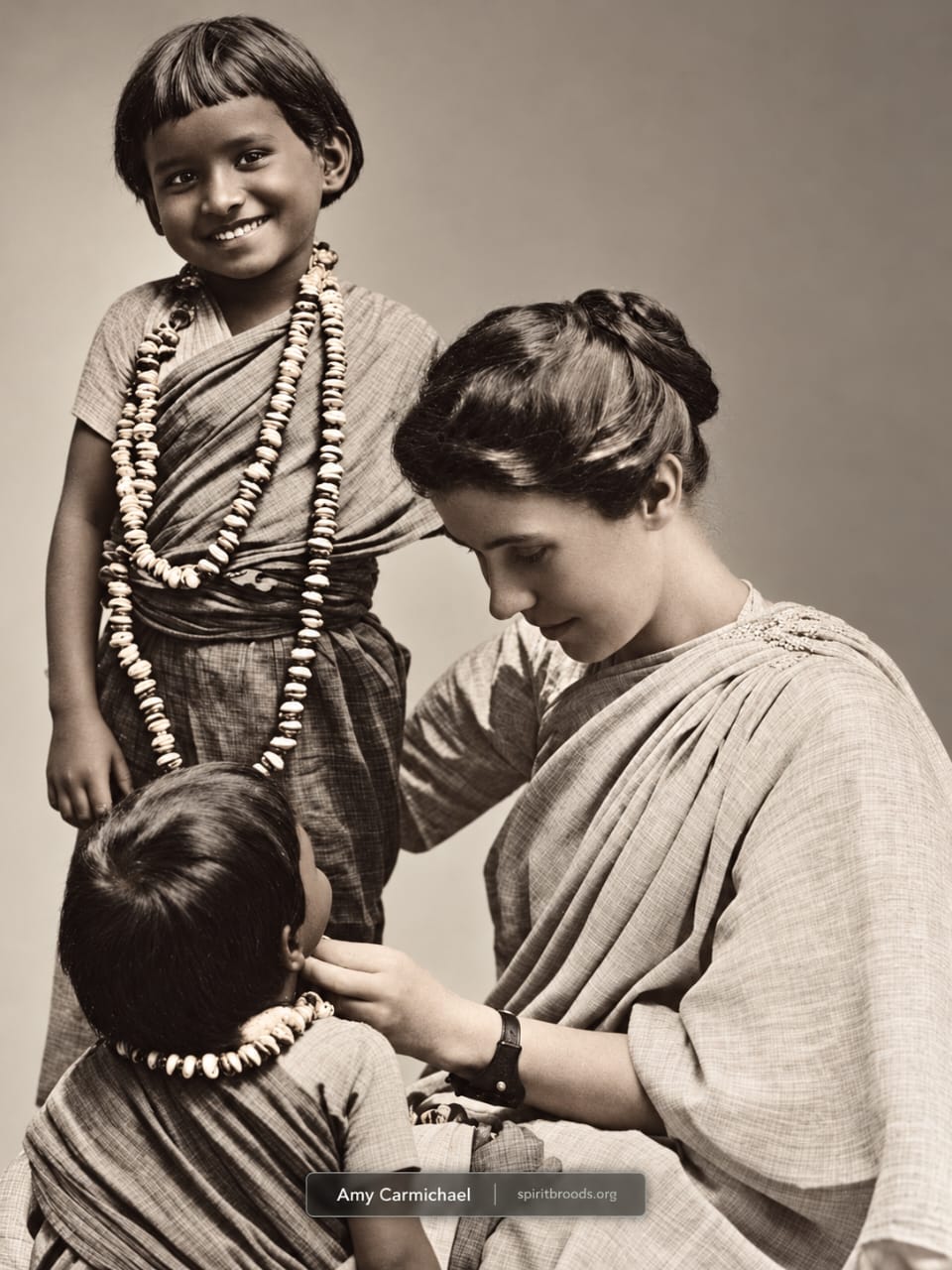
Biography
Amy Wilson Carmichael was born on December 16, 1867, in Millisle, County Down, in Northern Ireland. She was the eldest of seven children in a devout Presbyterian family. Her father owned a flour mill, and the family lived comfortably. As a child she had brown eyes, and she wished for blue ones. She prayed for blue eyes, and when she woke and found them still brown, she was disappointed. Years later she realized that God had given her the right eyes, for in India she would be able to pass as a native woman. The story shows her early habit of praying about small things.
After her father died in 1885, the family moved to Belfast. Amy became involved in work among the poor and led a group of girls known as the Shawlies, factory girls who wore shawls instead of hats. She came to know the great Keswick movement for holiness. She heard a message that stirred her to give herself wholly to God. She believed that God was calling her to a foreign field.
She went first to Japan in 1893 and found the work difficult and the climate harmful to her health. She then went to Ceylon, and in 1895 she arrived in southern India. She settled in the Tamil country and learned the language. She traveled with Indian women in a bullock cart, preaching in the villages. It was there that she learned of a hidden evil, the practice of dedicating young girls to the temples, where they were raised to serve as temple prostitutes. The practice was widely accepted, and few spoke against it.
In 1901 a seven-year-old girl named Preena ran away from a temple and came to Amy for protection. The child told her what happened in the temples. Amy took her in, and others soon followed. This was the beginning of the Dohnavur Fellowship. Over the next fifty years Amy and her coworkers rescued and raised hundreds of children. They lived as a family. She was known as Amma, the Tamil word for mother, and the children grew up under her care. The work later included boys who were also in danger.
She wrote about thirty-five books, many of them taken from the daily life of the community. Her best-known works include If, a short book on what love requires, and Gold Cord, the story of the Fellowship. She also wrote poetry and prayers. Her writing was simple and searching, and she called believers to take up the cross and to love as Christ loved. She repeatedly spoke of the cost of following Him.
In 1931 she fell into a pit and suffered severe injuries. She never fully recovered and spent the last twenty years of her life largely confined to her room. From there she continued to write and to guide the work. She endured chronic pain and long periods of weakness. She also faced criticism from outsiders who accused her of being too severe or too secretive. Some of her methods of running the Fellowship were strict, and those who lived under her care did not all find it easy. She did not hide the cost.
She died on January 18, 1951, at Dohnavur. She asked that no stone be placed on her grave. Instead, the children put a small birdbath over the place and carved on it a single word, Amma. Her life shows what a woman can do when she gives herself wholly to the care of the helpless, and it reminds us that love is proven in the daily and the hidden.
Sources
“We want to get to the lowest step down, low enough down to lift lost souls up.”
Archives
The Work at Dohnavur - Amy Carmichael
Contents
Millisle and Belfast
Amy Beatrice Carmichael was born on December 16, 1867, in Millisle, County Down, in what is now Northern Ireland.
She grew up in a Protestant Christian family of Scottish ancestry.
Her father, David Carmichael, was involved in the family milling business.
The household was comfortable enough to provide education, but Amy’s childhood was not a preparation for the kind of life she later lived in India.
She was strong-willed, imaginative and spiritually serious.
Some of the best-known childhood stories come through later devotional biography and should not be pressed beyond what the sources can carry.
What is clear is that Christian faith deepened as she grew older and that the death of her father changed the family’s circumstances.
The Carmichaels moved into a more difficult financial season.
Amy’s attention increasingly turned toward Christian service.
She began to see social conditions around her that respectable church life could overlook.
Family Loss and the Keswick Influence
The Keswick Convention became an important influence on Carmichael.
Keswick teaching emphasized surrender, holiness, the indwelling life of Christ and missionary service.
Carmichael absorbed the language of complete yieldedness.
She did not understand surrender as withdrawal from practical need.
For her, inward consecration should produce outward obedience.
After her father’s death she spent periods with Robert Wilson, a Christian businessman and supporter who became a father-like figure in her life.
She was never formally adopted, but for some years used the name Wilson-Carmichael.
Her connections with Keswick widened her missionary horizon.
They also brought her into a network through which overseas service became possible.
Ministry Among Working Women
Before leaving Britain, Carmichael worked among women employed in Belfast’s mills.
The conditions of industrial labour divided women socially as well as economically.
Carmichael became concerned for workers who felt uncomfortable in conventional church settings because of clothing, class or custom.
She helped create meetings intended for them.
The work eventually became associated with a building known as the Welcome.
This period matters because it showed a pattern that later appeared in India.
Carmichael noticed people whom existing religious arrangements did not easily receive.
Then she changed the arrangement rather than blaming the people.
She was not yet caring for children at Dohnavur.
But the instinct was already visible.
Christian work had to move toward those in need.
A Missionary Call and Closed Doors
Carmichael became convinced that she should serve overseas.
Her health complicated the calling.
She suffered from recurring neuralgia and periods of weakness.
In 1892 she offered herself to the China Inland Mission.
She was not accepted for China because of health concerns.
The rejection could have ended the plan.
Instead another route opened.
Through Keswick connections she went toward missionary service in Japan.
The fact that the first door closed became part of the pattern of her life.
She did not treat one institutional decision as the final word on the calling she believed she had received.
At the same time, health concerns were not imaginary.
Illness would follow her across continents and eventually confine her for the final decades of her life.
Japan
Carmichael went to Japan in 1893.
She worked in connection with Church Missionary Society ministry led by Barclay Fowell Buxton.
The Japanese period was relatively short.
She learned enough of the culture to discover how inadequate missionary assumptions could be.
She adopted local clothing and began learning the language.
Her letters from this period later contributed to her early book From Sunrise Land.
But her health deteriorated.
After roughly fifteen months, Japan no longer appeared sustainable.
She spent a period in Ceylon and returned temporarily to Britain.
From the outside, the missionary career looked unstable.
China had closed.
Japan had ended.
Health kept interrupting plans.
Then India became the place she never left.
Ceylon and the Road to India
In 1895 Carmichael went to South India under the Church of England Zenana Missionary Society.
She arrived in November.
The work initially focused on evangelism among women who, because of social custom, were often inaccessible to male missionaries.
Tamil became the language she had to learn.
She worked alongside experienced missionaries, including Thomas Walker.
India was under British imperial rule.
Every British missionary therefore entered a society shaped by a political imbalance whether or not the missionary personally supported imperial ideology.
Carmichael increasingly tried to reduce unnecessary distance between herself and Indian people.
She dressed in Indian clothing.
She travelled with Indian Christian women.
She learned from coworkers rather than building a ministry around herself alone.
The work remained explicitly evangelical.
Her goal was conversion to Christ.
But the form began to become more Indian than the conventional missionary station she had first entered.
South India and the Starry Cluster
Carmichael travelled with a group of Indian Christian women who became known in English accounts as the Starry Cluster.
They visited villages.
They spoke with women.
They taught Scripture.
The team allowed Carmichael to enter settings where a foreign missionary working alone would have been ineffective.
It also meant that her later reputation should not erase the Indian women who carried the work with her.
Missionary biography often centres the foreign founder because her letters were published in Britain.
The actual ministry was collaborative.
Indian women translated, interpreted social situations, cared for new believers and eventually became essential leaders in Dohnavur.
Carmichael’s gift was not that she did everything herself.
It was partly that she learned to build a family of workers around a shared purpose.
The Children Who Changed the Work
Around the turn of the century Carmichael began encountering children whose situations changed the direction of her ministry.
The name Preena appears repeatedly in Dohnavur memory as one of the first girls whose arrival brought the problem into focus.
Carmichael became convinced that some children dedicated in connection with Hindu temples were vulnerable to sexual exploitation and could not safely be returned to the circumstances from which they had fled.
The issue was difficult.
Families or temple authorities could demand children back.
A foreign Christian missionary intervening in religious customs could easily be accused of misunderstanding or attacking Hindu society.
Carmichael believed the danger to particular children was real.
She began accepting responsibility for them.
Evangelistic travel gradually gave way to the building of a permanent home.
The change cost her a form of ministry she loved.
She had imagined preaching across villages.
Instead her work became feeding, protecting, educating and raising children over years.
Dohnavur Fellowship
In 1901 Carmichael, the Walkers and Indian coworkers settled at Dohnavur in what is now Tamil Nadu.
The community that developed became known as the Dohnavur Fellowship.
Children arrived gradually.
Then the numbers grew.
Girls came first.
Boys were later received as well.
Housing expanded.
Schools developed.
Food had to be grown and prepared.
Clothing had to be made.
Medical needs increased.
Eventually the community included workshops, farms, nurseries and a hospital.
Carmichael resisted the language of an orphanage or impersonal institution.
Dohnavur understood itself as a family.
The ideal did not remove the realities of scale.
A family containing hundreds of children requires rules, authority, staff and organization.
But the language expressed what Carmichael wanted the children to experience.
They were not cases.
They belonged.
Temple Dedication, Exploitation and Historical Caution
Older missionary accounts often use the phrase “temple prostitution” as though it describes one simple institution across all of India.
The history is more complicated.
Devadasi traditions varied by region and period.
Women dedicated to temples could hold artistic, ritual and social roles that cannot be reduced without qualification to prostitution.
Colonial officials, Indian reformers and missionaries interpreted these traditions differently.
At the same time, sexual exploitation connected with the dedication of some girls was real.
Carmichael encountered children whom she believed were in danger and built a refuge for them.
The responsible historical approach is therefore neither to dismiss her testimony as colonial invention nor to repeat every missionary generalization about Indian religion as though it were an exact social description.
Specific children needed protection.
Carmichael acted because she believed returning them would expose them to harm.
Dohnavur’s history should be told around that concrete responsibility rather than around exaggerated claims about an entire culture.
Becoming Amma
The children called Carmichael Amma, mother.
The name became central to her identity at Dohnavur.
She never married and had no biological children.
Her life nevertheless became overwhelmingly maternal.
Motherhood in a community of this size was not sentimental.
Children became ill.
Some died.
Discipline was necessary.
Workers disagreed.
Resources had to stretch.
Older children needed education and a future beyond childhood.
Carmichael could be affectionate and playful.
She could also be demanding.
She expected workers who joined Dohnavur to accept a costly form of service.
She had little patience for romantic missionary enthusiasm that disappeared when ordinary tasks became difficult.
This severity grew from her own conviction that love was proved through endurance.
It could inspire.
It could also make her leadership difficult for people who did not share her temperament.
A Community Rather Than an Institution
Dohnavur developed systems because it had to.
There were houses for children.
There were schools.
There were kitchens and laundries.
There were agricultural operations.
A hospital was eventually established.
The work became a village within a village.
Yet Carmichael remained suspicious of institutional spirit.
She feared a ministry could continue outwardly after the original love had weakened.
This concern resembles warnings later made by figures such as Tozer, though the context was different.
For Carmichael the test was intensely practical.
Were children known?
Were workers serving because they loved Christ and the people in their care?
Had efficiency become more important than tenderness?
These questions were never solved once.
They had to be asked repeatedly as the Fellowship grew.
Money, Prayer and the Refusal to Advertise Need
Dohnavur depended heavily on gifts.
Carmichael preferred not to make direct public financial appeals.
She wrote extensively about the work, so supporters knew what existed.
But she wanted money to come through prayer rather than pressure.
The approach resembled other faith missions of the nineteenth and early twentieth centuries.
It required careful distinction.
Telling the story of Dohnavur inevitably made needs visible.
Books and letters drew supporters.
The work was therefore not financially invisible.
Carmichael’s rule concerned manipulation.
She did not want children displayed merely to produce donations.
This conviction became part of the Fellowship’s ethos.
It also increased the responsibility of leaders to manage resources carefully once they arrived.
Writing the Work Into Public View
Carmichael wrote extensively.
Things as They Are presented the spiritual and social conditions she believed missionaries faced in India.
Lotus Buds told stories connected with children.
Gold Cord narrated the development of Dohnavur.
Other works addressed prayer, suffering, mission and spiritual life.
Her writing recruited workers and supporters.
It also shaped how Western Christians imagined India.
That power requires historical caution.
Missionary writing was never a neutral camera.
Authors selected scenes to awaken prayer, giving and missionary commitment.
Carmichael sometimes used vivid contrasts between Christianity and Hindu practice.
Her love for Indian people was real.
So was her conviction that Hindu religious systems needed the gospel.
Modern readers should allow the texts to speak from that conviction while also reading Indian history beyond the missionary frame.
Discipline, Authority and the Demands of Dohnavur
Carmichael expected much from coworkers.
She believed Dohnavur could not be sustained by people looking for interesting religious work.
The daily labour was too ordinary and the emotional burden too high.
Workers had to accept anonymity.
They had to care for children through sickness and difficult behaviour.
They had to submit to communal discipline.
Carmichael’s authority in the Fellowship was substantial.
She was the founder, theological centre and public voice.
That concentration of authority helped preserve the work’s identity.
It could also make disagreement difficult.
Biographies written from within the Fellowship naturally emphasize the wisdom of her leadership.
A balanced record should recognize that strong founders can create both stability and dependency.
One of Carmichael’s important later tasks was therefore preparing others to lead without her.
The 1931 Fall
In 1931 Carmichael suffered a serious fall.
The injuries permanently restricted her movement.
Arthritis and earlier health problems added to the difficulty.
A woman whose ministry had once required constant travel now spent much of her life within a room.
The accident did not end her leadership.
It changed its form.
She continued writing.
She corresponded.
She advised workers.
She thought about succession.
The confinement also deepened the themes of suffering and hidden service in her later books.
She did not treat physical limitation as evidence that a calling had ended.
But neither should later readers romanticize chronic pain.
Restricted movement reduced choices.
Other people had to carry tasks she could no longer perform.
The Fellowship became less dependent on her physical presence because it had no alternative.
Twenty Years of Restricted Movement
Carmichael lived for roughly two decades after the fall.
These were not empty years.
Some of her most mature spiritual writing came from them.
She had time to reflect upon decades of work and upon the difference between visible activity and the hidden life of love.
She also watched Indian and missionary leaders carry greater responsibility.
This transition mattered because Carmichael had remained in India continuously since 1895.
She had never taken a furlough back to Britain or Ireland.
Dohnavur had therefore known her presence for an unusually long period.
A work built around one founder can become unstable when that person dies.
The long years of restricted movement forced succession to begin before death.
Death and the Work That Continued
Amy Carmichael died at Dohnavur on January 18, 1951.
She was eighty-three.
She had spent more than fifty-five years in India without returning to her homeland.
At her request, her burial place was not marked by an elaborate monument.
The children placed a simple marker associated with the name by which they knew her: Amma.
The Dohnavur Fellowship continued.
Its work changed over generations as Indian law, child-protection practice, education and society changed.
The institution now carries ministries in child care, education, health, rehabilitation and community development.
The fact that it survived its founder is one measure of the depth of the community she helped build.
What Her Life Was Protecting
Amy Carmichael’s life is often used to illustrate missionary sacrifice.
That is true but incomplete.
The deeper question is what the sacrifice was for.
She did not remain in India for fifty-six years in order to make endurance itself impressive.
She stayed because specific people had become her responsibility.
The centre of the Dohnavur story is not the foreign missionary.
It is the children.
Once that is remembered, several features of her life fall into place.
Evangelistic travel was surrendered because children needed a home.
Money was handled cautiously because vulnerable lives depended on the work.
Workers were tested because enthusiasm alone could not raise children.
Writing served the work by helping people understand it.
Even the long years after her injury were used to prepare a community that would continue without her.
Carmichael was strong-willed.
Her missionary interpretations belonged to her era and should be read critically.
Her authority could be demanding.
The social history around temple dedication requires more nuance than some older Christian books gave it.
None of that removes the central fact.
When children came to her in danger, she did not turn them into illustrations.
She made room for them to live.
Sources and references
- • Amy Carmichael, Things as They Are; Lotus Buds; Gold Cord and other Dohnavur writings. • Dohnavur Fellowship historical records and current institutional history. • Boston University History of Missiology, “Carmichael, Amy Beatrice (1867–1951).” • Frank Houghton, Amy Carmichael of Dohnavur, read alongside later historical scholarship. • Modern scholarship on the devadasi system, colonial reform and South Indian mission history, used to qualify older missionary terminology.