
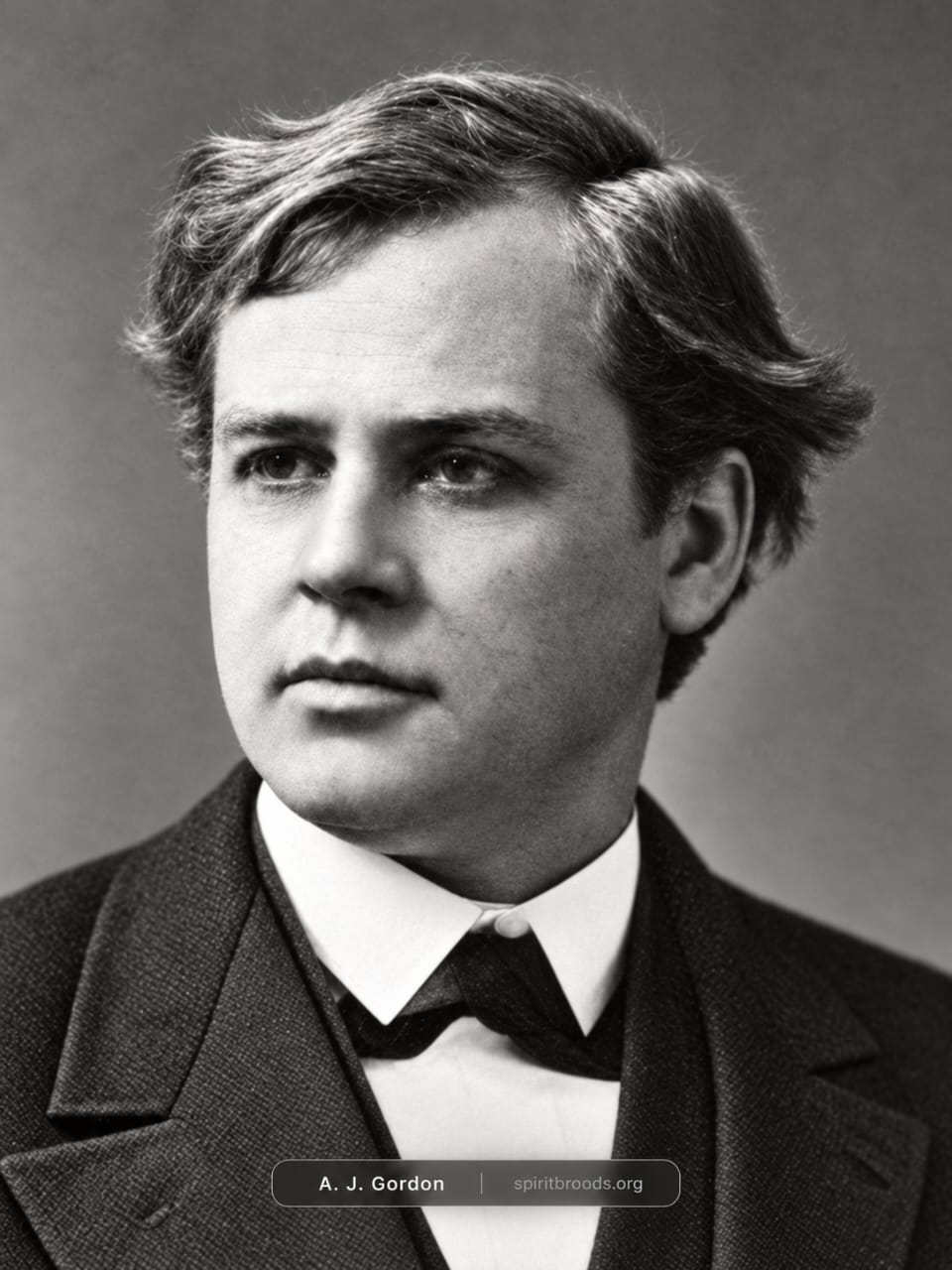
Biography
Adoniram Judson Gordon was born on April 19, 1836, in New Hampton, New Hampshire. His parents named him after Adoniram Judson, the pioneering missionary to Burma, and the name hung over him from his birth. He grew up in a poor farming family. As a boy he was converted, and he felt a call to the ministry early. He studied at Brown University in Rhode Island and then at Newton Theological Institution. He was a thoughtful and eager student.
He married Maria Hale, a woman of gifts and steady character who stood with him throughout his ministry. After seminary he pastored a church in Jamaica Plain, a part of Boston, and in 1869 he became pastor of the Clarendon Street Baptist Church in Boston. He remained there for the rest of his life. The church was in a wealthy part of the city, and in those years it grew in numbers and depth. He did not settle into comfort. He felt that the church had grown too easy, and he worked to turn its attention to the poor and to the lost.
He was also a deeply prayerful man who struggled with the question of the Holy Spirit's power. He read widely, and in the 1870s and 1880s his views changed. He came to believe in the premillennial return of Christ and in the ministry of the Holy Spirit as a living presence in the church. He also came to accept that God still heals in answer to prayer. These convictions cost him some friends. He wrote about them in books such as The Ministry of Healing and The Ministry of the Spirit.
He was a close friend of D. L. Moody and often preached at his conferences. He joined with Moody in the work at Northfield. He had a passion for missions, and he served as a leader of the American Baptist Missionary Union. He saw that the church needed workers who were trained quickly and practically for the foreign field. In 1889 he founded the Boston Missionary Training School to train men and women for ministry and for missions. After his death it was renamed in his honor and grew into Gordon College and later Gordon-Conwell Theological Seminary.
He also loved music, and he edited hymnals. He wrote the tune to the hymn "My Jesus, I Love Thee." He cared that the church sing the gospel and that its worship be simple. He was a careful writer and a tender pastor. He visited the sick, comforted the poor and gave large amounts of his own small income to those in need.
He had weaknesses as any man does. He took on too much, and he drove himself hard. In his last years his health failed, and he suffered from fatigue and from a heart condition. He also faced controversy over his unpopular views, and it grieved him. He kept a gentle spirit through it.
He died on February 2, 1895, at the age of fifty-eight. The school he began continues and has trained generations of ministers. His life shows what a pastor can do when he feels the weight of the nations and gives his strength to equip others to go.
Sources
“The Spirit is the breath of God in the body of his church.”
“In a word, so vital and indispensable is the ministry of the Spirit, that without it nothing else will avail.”
“The keynote of all true intercession is the will of God.”
“It is the Spirit's deepest work in the believer to attune his mind to this exalted key.”
“To pray rightly is the highest of all attainments.”