
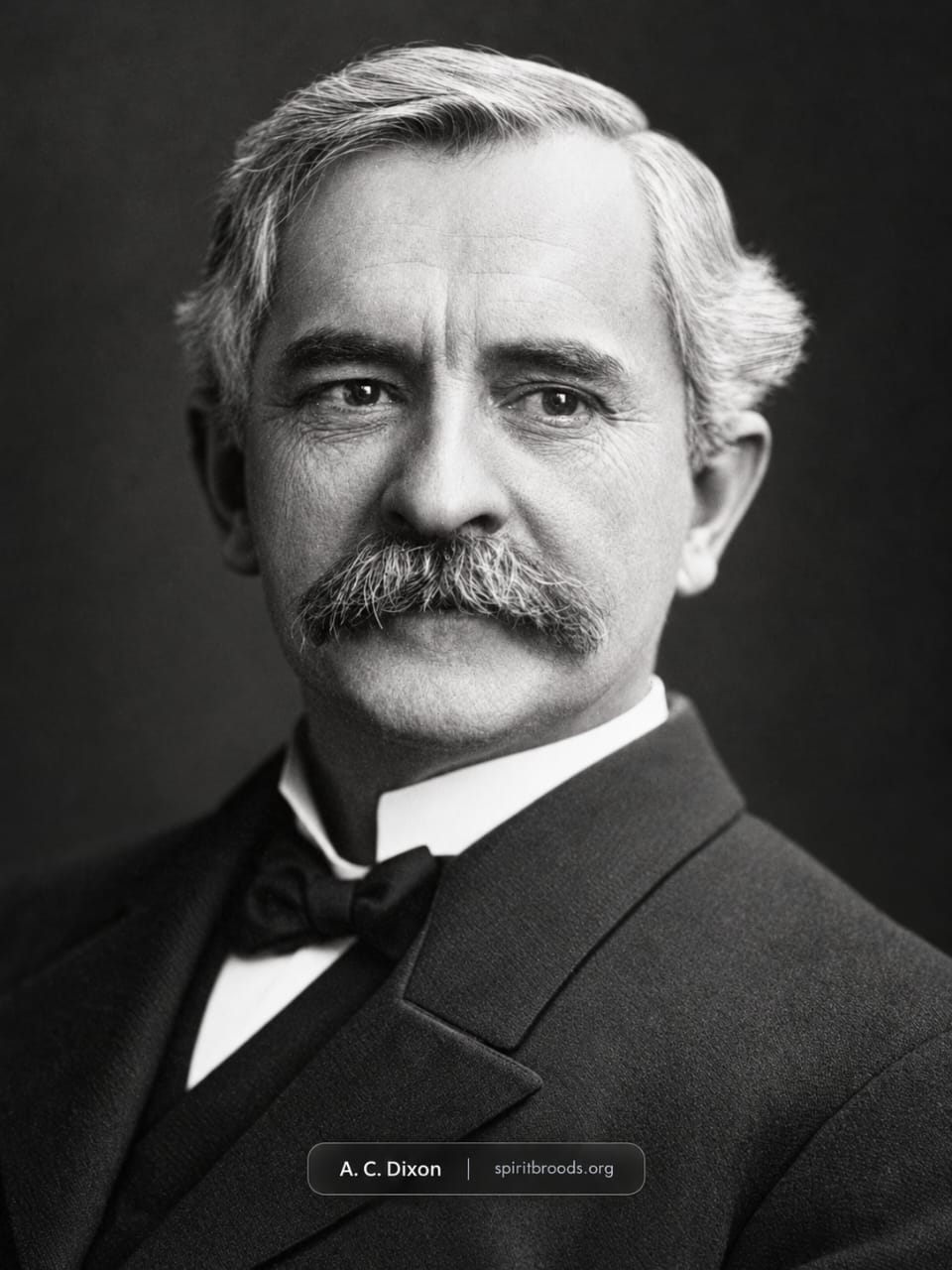
Biography
Amzi Clarence Dixon was born on July 6, 1854, in Shelby, North Carolina. His father was a Baptist minister, and the home was strict, warm and full of the Bible. He was converted as a boy and was baptized in his early teens. He studied at Wake Forest College and then at the Southern Baptist Theological Seminary. He was a tall, vigorous man who loved people and spoke with a plain, straight force.
He began his ministry in small North Carolina churches and soon moved to larger pulpits. He pastored in Chapel Hill, then in Baltimore, and then in Brooklyn at the Hanson Place Baptist Church. Everywhere he went, his preaching drew crowds and many came to faith. He was known for the way he held to the Bible as the Word of God and for his stress on prayer. He once said that when we depend on organization we get what organization can do, and when we depend on prayer we get what God can do.
In 1906 he became pastor of Moody Church in Chicago, the church that grew out of the work of D. L. Moody. He remained there for five years. In that time he helped to plan and edit the first volumes of a series of booklets that came to be called The Fundamentals. They were sent free to pastors and missionaries around the world and set out the central truths of the faith in answer to the doubts that were spreading through the church. Dixon edited the early volumes before the work passed to others.
In 1911 he accepted a call that few men would have dared to accept. He became pastor of the Metropolitan Tabernacle in London, the great church where Charles Spurgeon had preached for decades. Spurgeon's shadow lay heavily on that pulpit, and the church had known a time of decline since his death. Dixon served there during the years of the First World War, with bombs falling on the city and the congregation scattered by military service. He preached through those years and kept the church going. He left in 1919.
He returned to the United States and served at a church in Baltimore and then took the pastorate of a church in Chicago. He kept up a heavy schedule of preaching and writing. He wrote on evangelism, on the Bible and on the work of the Holy Spirit. He also had a hand in the early life of Bible schools in America and was a popular speaker at conferences.
He had a younger brother, Thomas Dixon Jr., who became a popular novelist and whose books carried harsh and racist views of the American South. The two men took different paths. A. C. Dixon did not share his brother's career, and it should be said honestly that men of his time and place were often shaped by the attitudes around them and needed to be corrected by Scripture. His strengths lay in his boldness for the Bible and in his belief that the church was hindered most by its lack of prayer.
He died in 1925 in England, while on a preaching trip. He had given himself to the Word and to the nations. He is remembered mostly for the pulpits he held and the Fundamentals he helped to launch. His life shows the strain that comes on a man who follows a giant, and how a faithful pastor can serve in another man's shadow and still be used by God.
Sources
“He must keep right with God and speak the Word of God, while he trusts the Spirit of God. No valley of bones can resist a man of this kind.”
“The Spirit uses His own sword, the Word of God; and when we substitute our words for His, we substitute weakness for strength.”
“Prayer is the key to success. Not to pray is to fail. To pray aright is never to fail.”
“A revival that comes in answer to prayer is God-given, the only kind worth having. A revival gotten up is soon put down.”
“The man of God spoke the Word of God in the power of the Spirit of God.”
“It is well to be a man of learning, a man of position, a man of means, a man of eloquence, but it is a thousand times better to be a man of God.”
“Every worker in the valley of bones needs these qualifications. He must be a man of God, a man of the Bible and a man of prayer.”
“To the man whose faith is in God alone the hopeless becomes hopeful.”
“What every dry bone of the valley needs, first of all, is a touch of the breath of God.”
“The work cannot be done at a distance.”
“A true revival is a quickening according to God’s Word, not according to some man’s magnetism or eccentricity.”
“What we need now for quickening is not so much money and wisdom as the spirit of supplication.”
“If the fire begins in your soul, the flames will catch the combustible material about you.”
“We need men and women who believe something definite and are willing to live and die for their faith.”
“Obedience, not sentimentalism or unctuous joy, is love.”
“We need a quickening of faith; faith in the power of the God of Pentecost to convict and convert three thousand in a day.”
“Knowing how and what is not sufficient. We must take time to do it, for God works in answer to prayer, and God at work is our greatest need.”
“He dwells not where He is not wanted.”
“What we want is a fresh revelation of Christ.”
“In Jesus Christ on the Cross, there is refuge; there is safety; there is shelter; and all the power of sin upon our track cannot reach us when we have taken shelter under the Cross that atones for our sins.”
“No difficulty can surpass His resources.”
“One live Lazarus is worth forty sermons on the resurrection.”
“We have enough of church machinery. We pray for more power.”
“Give us a genuine Christianity that may provoke persecution, but will not provoke contempt.”